Nigeria’s nutrition advocacy landscape is witnessing a significant transformation as the Civil Society–Scaling Up Nutrition in Nigeria (CS-SUNN), under the Partnership for Improving Nigeria Nutrition Systems (PINNS 3.0) project, successfully implemented a comprehensive nationwide capacity strengthening initiative for its state chapters and civil society organisations.
Conducted across multiple states — including Bauchi, Kaduna, Kano, Niger, Lagos, Nasarawa, FCT, Zamfara, Adamawa, Abia and Benue — the three-day intensive training on programmatic leadership, governance, Key Performance Indicators (KPIs), effective advocacy, alliance protocols, resource mobilization and annual work plan represented a major milestone in building resilient subnational civil society structures for nutrition action in Nigeria.
Altogether, over 283 state chapter executives and civil society actors participated in this coordinated effort, one of the most far-reaching capacity strengthening programs for nutrition-focused civil society coalitions in recent years. The workshop deliberately reflected Nigeria’s geopolitical diversity, spanning North-East (Bauchi, Adamawa), North-West (Kano, Zamfara), North-Central (Niger, Nasarawa, FCT, Benue), South-West (Lagos), and South-East (Abia). This inclusive approach reinforced national ownership, equity and a unified civil society movement capable of advancing nutrition priorities across all regions.
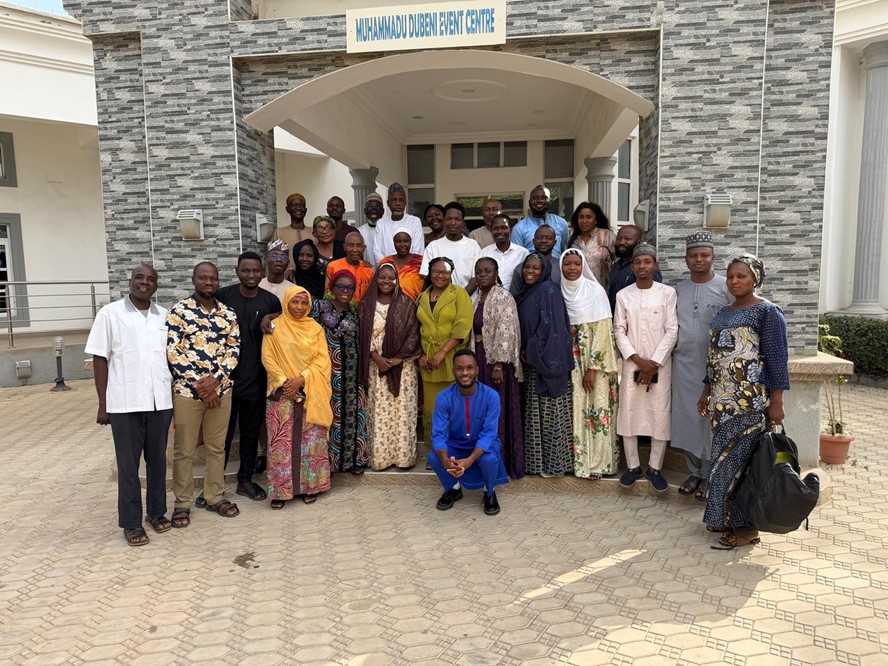
The training addressed critical gaps at a time when Nigeria continues to face high rates of malnutrition, anaemia and suboptimal nutrition financing, especially at the subnational level. While national policies and frameworks exist, their effectiveness depends on strong state-level actors who can drive accountability, influence policies, mobilize resources and sustain advocacy. This workshop equipped chapters with the leadership, systems and tools needed to bridge these gaps.
Summary Analysis of improvement in knowledge gained:
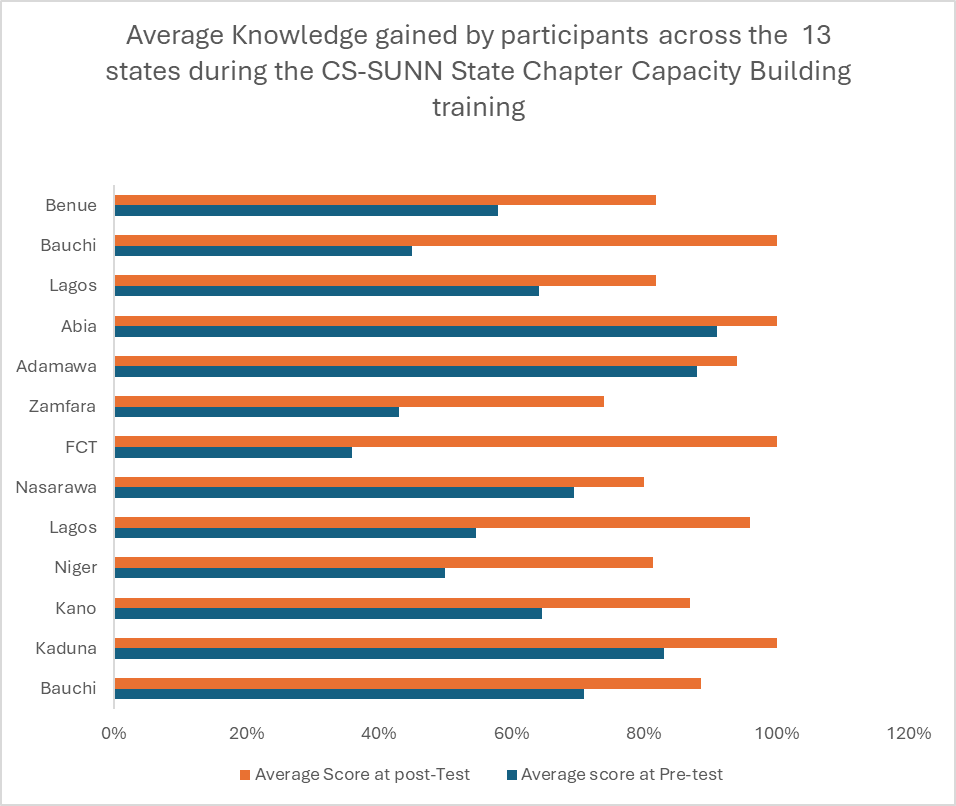
A key feature of the training was the use of structured pre- and post-training knowledge assessments to measure learning outcomes. These results translate to an average performance increase of approximately 6.2% and a median improvement of 7.1%. Notably, the post-training median score of 26 out of 28 shows that at least half of the participants achieved over 92% on the test, indicating strong overall mastery of the training content.
The upward shift in both average and median scores demonstrates that the training was highly effective. Even though participants entered the program with a relatively strong baseline (averaging over 84%), the majority still recorded noticeable improvements. This suggests the sessions successfully addressed knowledge gaps and deepened understanding in key technical areas.
For some members, the gaps were deeply personal. Dr. Aisha Waka, State Coordinator in Niger, described her experience candidly: “The greatest challenge I faced was my ability to coordinate. I didn’t know how to go about it. I didn’t even know where to start from.” These improvements confirm that participants acquired substantial new knowledge and practical skills in areas such as programmatic leadership, advocacy techniques, accountability mechanisms, alliance protocols, KPIs for performance tracking, sustainability strategies and stakeholder engagement. The gains were consistent across most participants, demonstrating the training’s effectiveness in enhancing understanding. Similar knowledge assessment approaches and positive outcomes were observed or reported across other participating states, underscoring the workshop’s success in building technical and strategic capacity.
Core Achievements and Transformative Outcomes
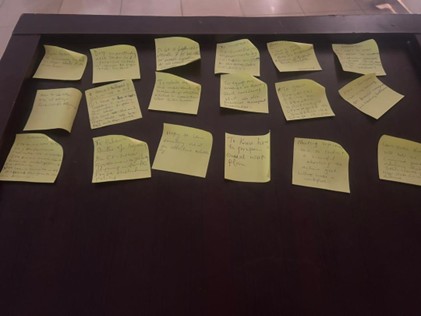
Participants engaged in highly interactive, participatory sessions that moved beyond theory to co-creation. State executives and members jointly developed role-specific Key Performance Indicators (KPIs) for positions including state coordinators, secretaries and leads in advocacy, resource mobilization, policy & research, capacity building and partnerships. These KPIs established clear, measurable benchmarks covering governance, financial management, stakeholder engagement, fundraising, evidence-based advocacy, timely reporting and membership mobilization.
Complementing the KPIs, chapters collaboratively developed realistic annual state workplans aligned with both national CS-SUNN priorities and their state and communities specific contexts. This process strengthened planning skills, improved alignment between national and subnational efforts and created structured roadmaps for implementation, monitoring and evaluation.
Key knowledge and skill gains included:
- Programmatic leadership and effective chapter management.
- Development and application of KPIs for performance tracking, accountability and evidence-based decision-making.
- Deeper understanding of CS-SUNN’s mission, constitution, governing manuals and alliance protocols.
- Sustainability strategies, local resource mobilization, financial management and reducing over-reliance on national support.
- Evidence-based advocacy, strategic communication, stakeholder engagement, policy influence and budget tracking.
Participant Voices and Real-time Impact
The training fostered renewed commitment, confidence, and a shift in mindset. Testimonies captured the transformation:
“Before this capacity strengthening the greatest challenge that I faced was my ability to coordinate. I didn’t know how to go about it. I didn’t even know where to start from. But this has helped me to know my roles exactly, but now I know my roles one after the other. It has helped me to know the ways to go about how to plan, how to be a programmatic leader and then how to help me manage with the focusing” — Dr. Aisha Waka, State Coordinator, CS-SUNN Niger State Coordinator.
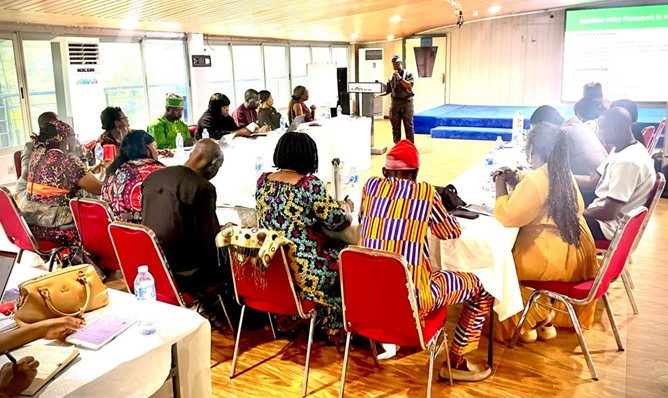
In Kano State, similar needs were identified. While leadership structures existed, there was limited clarity on governance instruments such as the CS-SUNN Constitution and Governing Manual. Executive officers required stronger programmatic leadership capacity, clearer accountability systems, and improved financial management knowledge to enhance organizational sustainability under PINNS 3.0. For Hassan Ibrahim Gama, Executive Director Friends of the Community Organization (FOCO), State Chapter Member, “I express my appreciation to CS-SUNN for the opportunity to actively participate during the facilitation process, the sessions deepened my understanding of leadership and the coalition. I now have a clearer sense of my role and expectations”. Across all three states, the pattern was clear: leadership passion existed, but systems for accountability and measurable performance were weak.
Mohamed Mohamed- Executive Director of Voice of Electric and the Chairperson of Research and Policy of CS-SUNN Niger state reflected: “It has widened my scope. It has opened my eyes. It has inducted me with relevant skills, especially in policy governance, documentation and evidence-based data.”
In Lagos State, the same process reinforced clarity of roles, strengthened KPI adoption and ensured that state-level advocacy activities would align with national strategic priorities”. For Aippoh, Lead, Research, CS-SUNN Lagos State Chapter “Breaking down leadership responsibilities and KPIs in such a practical way has given us clarity on what success should look like at state level and how to measure it.”
Sustainability and Long-Term Institutional Strengthening
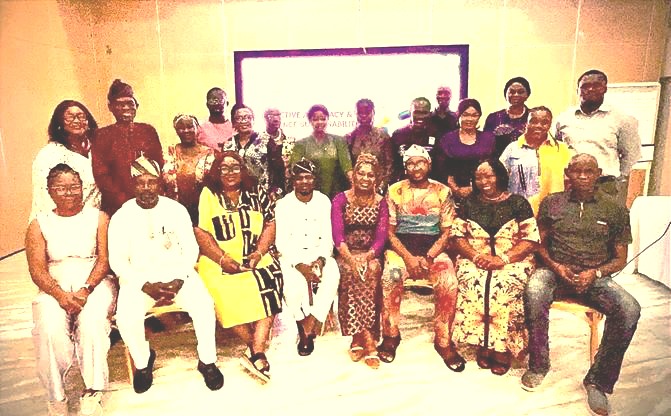
A major focus was building self-reliance. Chapters committed to stronger internal coordination, regular congress meetings, timely reporting, local fundraising (including membership dues), proposal development and transparent financial systems. This shift supports greater local-level ownership and resilience, ensuring nutrition advocacy can continue effectively regardless of external funding fluctuations.
By strengthening over 283 civil society leaders, CS-SUNN has contributed to enhancing subnational governance and accountability systems for nutrition. Empowered state chapters are now better positioned to:
- Influence state nutrition policies and budgets.
- Monitor program implementation.
- Track performance using KPIs.
- Document evidence and success stories.
- Drive community mobilization and multi-stakeholder engagement.
This represents a strategic investment in sustainable civil society architecture. Strong, accountable, and self-reliant state chapters form the backbone for translating national commitments into local impact, ultimately contributing to better maternal and child nutrition outcomes across Nigeria. Mr. Shehu Ahmed Baba from the Center for Communication and Reporting for Health Services in Niger State explained: “Now that we know CS-SUNN has a body, a constitution, we can use the coalition to access funds and strengthen advocacy.” As Kalejaye expressed in Lagos: “If we work as a coalition, we can move mountains.”
State chapters are already translating gains into action — operationalizing KPIs, rolling out workplans, conducting step-down trainings, and strengthening partnerships. CS-SUNN will continue providing mentorship, technical support and monitoring to ensure sustained application of the new tools and frameworks. Lessons from implementation will inform future capacity development efforts.
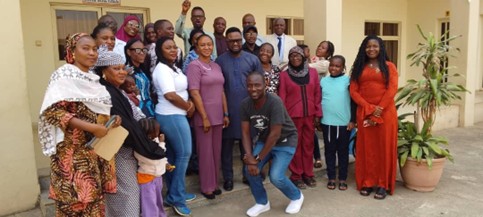
This nationwide capacity strengthening program is more than a series of trainings — it marks a key shift toward a more coordinated, results-oriented, and sustainable civil society network. With enhanced leadership, clear performance systems and renewed commitment, CS-SUNN state chapters are powerfully positioned to advance Nigeria’s nutrition agenda and contribute more meaningfully to ending malnutrition. 283 leaders now operate with clearer mandates. 13 state chapters now function with structured annual workplans. KPIs now anchor performance measurement. The alliance identity is stronger. Governance documents are understood. Advocacy is becoming evidence-driven. Dr. Aisha’s words summarize the transformation: “Now I know my roles. I know how to plan. I know how to be a programmatic leader.”